The SVS is ITIL’s engine. And with the CATALYX Framework, you can make sure it never stalls.
👉 If you haven’t read the earlier posts, I highly recommend checking them out:
We started with ITIL 4’s Key Concepts 🍕 (and why they matter in practice).
Then we explored the Four Dimensions of Service Management — and showed how CATALYX turns them into real execution.
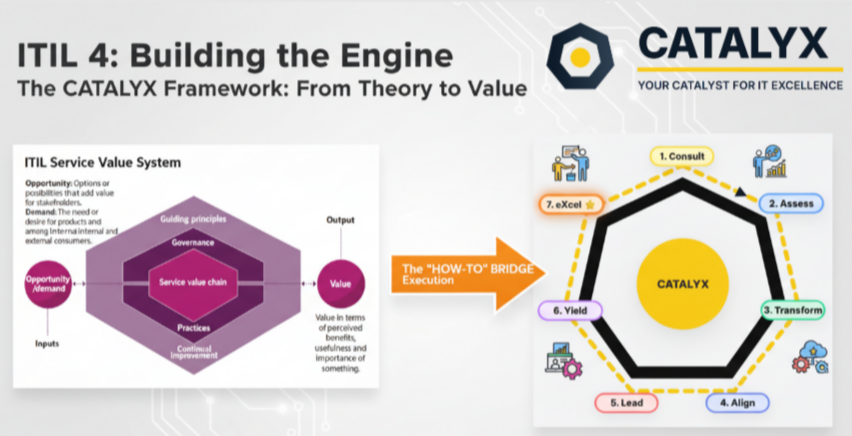
Now, let’s zoom out to the entire system: the Service Value System (SVS). The SVS is the holistic model for how every single component and activity in your organization works together to facilitate value creation.
At its core, the SVS is simple: Opportunity + Demand → Value.
📌 But here’s the catch: SVS diagrams look brilliant on a whiteboard, yet most organizations struggle to make the parts work together in real life.
That’s where the CATALYX Framework provides the essential operational design. It's the practical structure that connects ITIL’s five SVS elements. Let’s dive into the engine!
⚙️ The Five Essential Elements of the SVS
1️⃣ Guiding Principles: The Non-Negotiables 🧭
ITIL says: These are universal recommendations that guide an organization in all circumstances (Focus on Value, Start Where You Are, etc.).
The struggle: Principles often become motivational posters. Teams claim to "Focus on Value" but spend all their time on reactive work that adds none.
🍕 Pizza shop: The pizza shop owner believes in quality but continues to use slow delivery systems because upgrading is too hard.
🔑 CATALYX view: We embed principles directly into execution. We use the CATALYX stages (Consult, Assess, Transform) to force alignment between principles and practices, ensuring decisions are consistently mapped back to a measurable principle.
2️⃣ Governance: The Steering Wheel 👑
ITIL says: How the organization is directed and controlled.
The struggle: Governance is seen as bureaucracy, so people bypass it with shadow IT.
🍕 Pizza shop: The pizza shop's central office mandates a new reporting tool, but the store managers ignore it because it slows down order taking.
🔑 CATALYX view: The Lead stage of CATALYX is dedicated to Governance, Risk & Compliance. We help you design lightweight, outcome-focused governance that manages risk without crippling speed, ensuring direction and control are aligned with the value streams.
3️⃣ Service Value Chain (SVC): The Assembly Line 🏭
ITIL says: Six activities (Plan, Improve, Engage, Design & Transition, Obtain/Build, Deliver & Support) that turn demand into value.
The struggle: These activities are typically siloed. Hand-offs between "Obtain/Build" (DevOps) and "Deliver & Support" (Operations) become a major source of friction and failures.
🔑 CATALYX view: The entire CATALYX framework is designed to optimize the SVC. By prioritizing Value Streams & Processes, we break down silos and automate handoffs to create a seamless, end-to-end flow. (We deep-dive into this in the next post!).
4️⃣ Practices: The Toolset 🛠️
ITIL says: A set of organizational resources designed to perform work or accomplish an objective (e.g., Incident Management, Relationship Management).
The struggle: Organizations treat practices as isolated processes (like Incident Management), failing to integrate them into the overall flow of value creation.
🍕 Pizza shop: The pizza shop has a great "Order Taking" practice but a terrible "Stock Management" practice, meaning they take orders for ingredients they don't have.
🔑 CATALYX view: We apply the Yield and eXcel stages to your practices. We measure and report on the cost savings and efficiency gains, ensuring that every practice is optimized and contributing to the holistic service delivery.
5️⃣ Continual Improvement: The Feedback Loop 🔄
ITIL says: A recurring activity performed at all levels to ensure performance continually meets stakeholders’ expectations.
The struggle: Improvement often gets reduced to an annual review or a simple backlog of minor tasks, lacking strategic direction or impact.
🍕 Pizza shop: Feedback ignored until bad reviews pile up.
🔑 CATALYX view: This is the core of our eXcel stage. We don't just ask for improvement; we embed a culture of optimization into the daily rhythm, using data to drive large-scale, transformative improvements that continue to grow value even after go-live.
🎯 Wrapping Up: The SVS Needs Direction
The Service Value System provides the complete map for value creation. But a map doesn't drive the car.
ITIL tells you what the components are. CATALYX provides the strategy, the governance, and the execution model to make the SVS operate as a cohesive, high-performance engine.
The CATALYX Framework ensures your SVS is:
✅ DIRECTED by Guiding Principles.
✅ CONTROLLED by effective Governance.
✅ OPTIMIZED through Continual Improvement.
🔜 What’s Next
In the next post, we will finally dive deep into the engine's core: the Service Value Chain (SVC)—and show how CATALYX organizes those six key activities for maximum flow and efficiency. Don't miss it!
💬 Over to you: Which SVS element is the weakest link in your organization right now—Principles, Governance, the SVC, Practices, or Continual Improvement?
🚀 Stop Drawing Diagrams: The ITIL 4 Service Value System is the Engine of Your Success


Leave a Comment