At Catalyx, we specialize in **bridging the gap** between businesses and their IT service providers.
At Catalyx, we specialize in **bridging the gap** between businesses and their IT service providers.
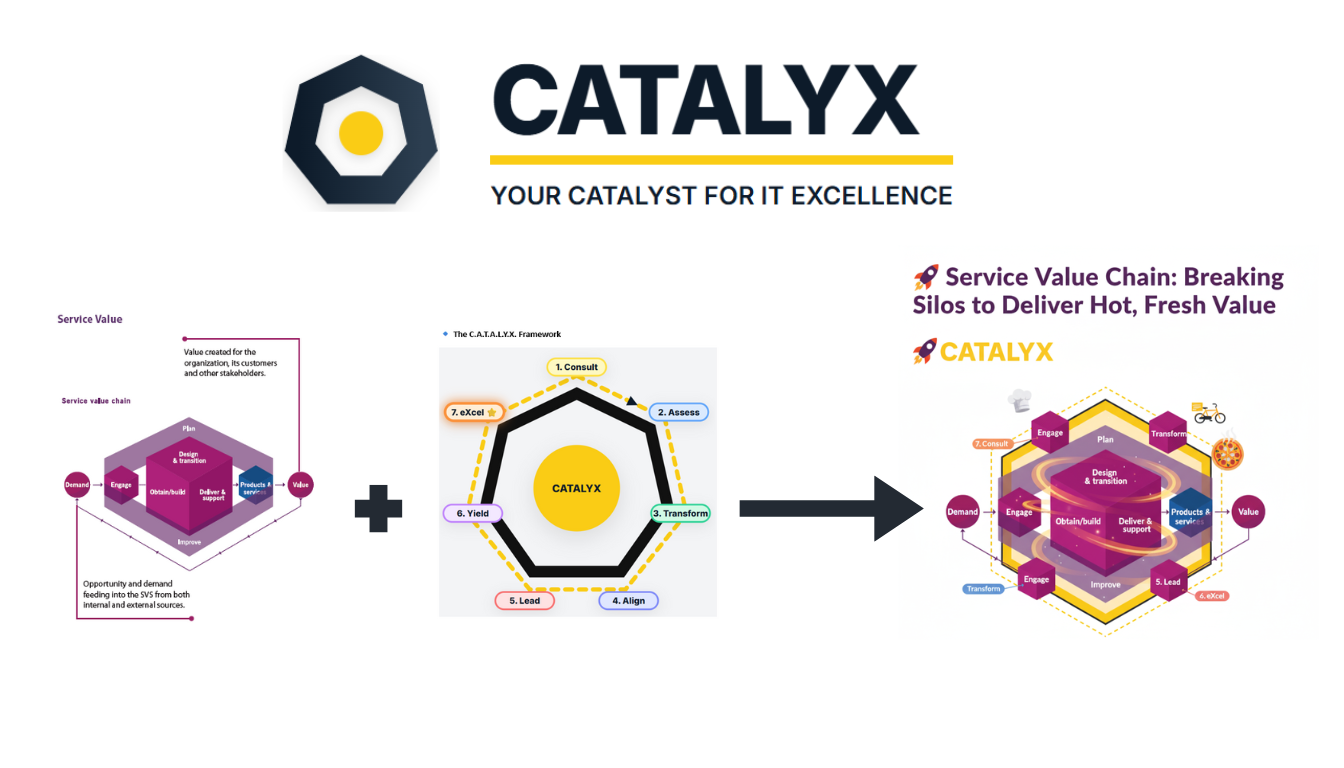
If you’ve followed the series so far — first, we explored ITIL 4’s Key Concepts 🍕 (the mindset). Then the Four Dimensions (the environment). Most recently, we unpacked the Service Value System (SVS) — the engine that connects everything together. Now it’s time to start that engine and see it run.
Welcome back to the engine room! If the Service Value System (SVS) gave us the blueprint for value, the Service Value Chain (SVC) is where the actual construction happens and ideas become real, valuable outcomes. At its simplest, the SVS told us what makes value possible. The SVC now shows us how it’s actually created.
🏭 The Service Value Chain: From Order to Outcome
Think of your organization as a pizza shop 🍕.
The SVS gave you the oven, the chefs, and the menu. The SVC is the assembly line — from taking the order to delivering the hot pizza.
Every order (or customer demand) goes through six activities — sometimes in sequence, sometimes in parallel — to create value:
1️⃣ Plan
2️⃣ Improve
3️⃣ Engage
4️⃣ Design & Transition
5️⃣ Obtain/Build
6️⃣ Deliver & Support
📉 The Real-World Struggle: Silo City
ITIL’s design is brilliant. But most organizations run the SVC like six separate kitchens that never talk to each other:
💬 Engage (service desk) operates in isolation from Deliver & Support (operations).
⚙️ The Obtain/Build team (DevOps) throws work over the wall to Support, creating endless firefighting.
🧾 Approvals between Plan and Design take days — value stalls before it even starts cooking.
🍕 Pizza Example: The “Design & Transition” team launches a new gourmet pizza menu — but they never check with the delivery team about box sizes or ingredient availability. Result? Great ideas, poor execution, and cold pizza.
⚙️ How CATALYX Supercharges the SVC: Turning the Chain into Flow
CATALYX treats the Service Value Chain not as six boxes, but as a single, flowing pipeline of value.
We apply our stages — Consult, Assess, Transform, Lead, Yield, and eXcel — across the SVC to connect strategy, people, process, and performance into one cohesive system.
1️⃣ CONSULT & ASSESS → Designing the Optimal Value Stream
Before you begin, you need to know where the value is created and where the bottlenecks are. 🔑CATALYX Action: We map your current, "as-is" value chain (using our Assess stage) and pinpoint the highest-value, most-broken streams.
Is it your 'Request to Fulfill' stream? Or your 'Demand to Deploy' stream?
💡SVC Impact: This directly informs where your Plan and Improve activities must focus their resources for maximum ROI. We ensure your Engage activity feeds clear demand into a validated stream.
2️⃣ TRANSFORM & LEAD → Automating the Handoffs
This is where most organizations fail: the gaps between Design, Build, and Support.
🔑CATALYX Action: Our Transform stage focuses on process automation and tooling integration, specifically targeting the handoff points between Design & Transition and Obtain/Build (DevOps integration). Our Lead stage establishes the light-touch governance to maintain the integrated flow.
💡SVC Impact: We turn the dangerous handoff between Dev and Ops into a continuous, automated flow, resulting in faster time-to-market and more stable services in Deliver & Support.
3️⃣ YIELD & eXcel → Measuring the End-to-End Value
You can’t improve what you don’t measure. The true test of the SVC is not how fast one activity performs, but the efficiency of the entire chain.
🔑CATALYX Action: The Yield and eXcel stages install the metrics, dashboards, and feedback loops to measure the flow rate and lead time of your entire Value Stream, not just individual activities.
💡SVC Impact: This forces Continual Improvement to become a strategic, data-driven activity, always focused on removing the constraint that is slowing down the complete chain's ability to create value.
🎯 Wrapping Up: The Chain Is Only as Strong as Its Links
The Service Value Chain is the heart of ITIL 4 — but it only beats effectively when its six activities work together as one.
CATALYX ensures your SVC:
✅ Flows seamlessly across teams.
✅ Automates friction-heavy handoffs.
✅ Measures and improves value continuously.
It’s the difference between a chaotic kitchen and a high-performing pizzeria that delivers value — hot, fresh, and on time. 🍕
🔜 What’s Next: Mastering the Tune-Up
We’ve covered the SVS (the engine) and the SVC (the assembly line).
Next, we must install the performance tuning system. We are diving into Continual Improvement (CI).
We’ll explore the ITIL 4 CI Model—the essential framework for optimization—and show how our CATALYX eXcel stage transforms CI from an annual aspiration into a daily, data-driven culture that keeps your entire service value system running faster, better, and always aligned with value.
Stay tuned—that’s where operational excellence becomes a reality. 🚀
Service Value Chain: Breaking Silos to Deliver Hot, Fresh Value

Leave a Comment